
When a Home Isn’t Really Yours: How Title Protection Can Save Your Investment
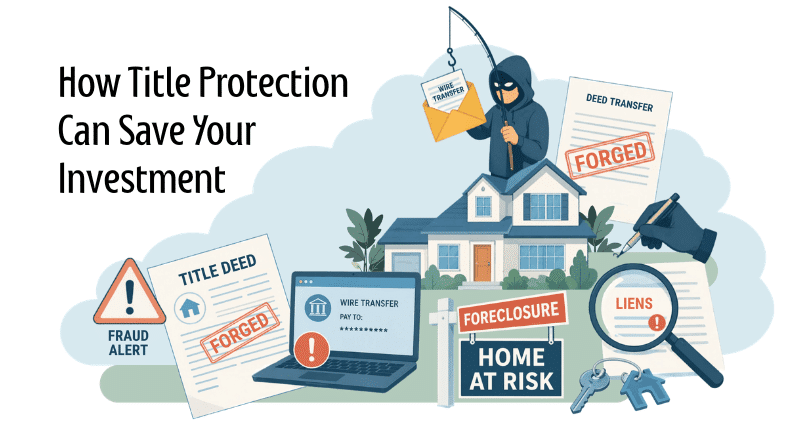
Buying a home is one of the largest financial decisions most people will ever make. It feels secure—signed documents, recorded deeds, and a set of keys in hand. But real stories across the country show that without proper title protection, that sense of security can disappear quickly.Public records do not guarantee that ownership is valid—they simply record documents. That means fraudulent or inaccurate filings can still make their way into the system. When that happens, the financial consequences can be severe.
REAL CASE#1: Fraudulent Deed Transfer
- A stranger filed a fake deed and transferred ownership of a multi-million-dollar home.
- The county recorded the document without verifying its authenticity.
- The rightful owner had to fight legally to recover the property.
TAKEAWAY:
Fraud can happen without your knowledge. Proper title verification helps catch red flags early.
REAL CASE#2: Wire Fraud at Closing
- Homeowners sold their house expecting payment at closing.
- Hackers intercepted wiring instructions and redirected the funds.
- The home was sold—but the sellers never received their moneyThe rightful owner had to fight legally to recover the property.
TAKEAWAY:
Secure communication and trusted processes are critical during closing.
REAL CASE#3: Buying from a Fraudster
- Criminals posed as property owners and sold homes they didn’t own.
- Buyers completed what appeared to be legitimate purchases.
- They later faced the risk of losing both the home and their investment.
TAKEAWAY:
Without proper title protection, buyers may have little recourse.
CLOSE WITH PEAK CONFIDENCE

Comprehensive on-site Title Plant and Title Underwriting services • Quick and efficient Title Commitments and Closings • For Your Real Estate Closings, Insist on Sierra.
REAL CASE#4: Quitclaim Deed Fraud
- Fraudsters forged signatures and transferred ownership through fake documents.
- They then attempted to sell or borrow against the property.
TAKEAWAY:
Ownership can be compromised without physical intrusion—paper fraud is enough.
REAL CASE#5: Home Sold Without Owner’s Knowledge
- Scammers forged documents and sold a home for cash.
- The real owners didn’t know until after the transaction
TAKEAWAY:
Even fully owned homes are vulnerable without safeguards.
These cases are not rare—they are increasing. And they all point to one thing: the importance of working with a trusted title company.
A reputable provider like Sierra Title Company plays a critical role in protecting buyers and sellers. Before closing, a detailed title search is conducted to verify ownership history, uncover liens, and identify issues that could affect the transaction. This process helps prevent problems before they happen.
Title insurance adds another layer of protection. An owner’s policy helps cover financial loss if a title issue is discovered after closing—whether it’s a hidden lien, recording error, or fraud.Without it, resolving these issues can be costly and time-consuming.
Security is equally important. Established title companies follow strict procedures to reduce the risk of wire fraud and verify all parties involved in the transaction.
The bottom line is simple: not all real estate transactions offer the same level of protection. Choosing experienced professionals who prioritize accuracy and security can make all the difference.
A home should represent stability—not risk. Taking the right steps during the buying process helps ensure that what you purchase is truly yours, now and in the future.
New Homes Guide Magazine
The latest new home trends, up-and-coming neighborhoods, and more.
© RGV New Homes Guide, 2026. Unauthorized use and/or duplication of this material without express and written permission from this site’s author and/or owner is strictly prohibited. Excerpts and links may be used, provided that full and clear credit is given to RGV New Homes Guide with appropriate and specific direction to the original content.


